To the Reader:
This article is the briefest defense I can offer for the Theory of Unconscious Response™.
I am interested in bringing this discovery to as wide an audience as possible. Anyone who will take the time to read through this paper will have an opinion that comes from your personal experience. I ask for your thoughts about what is presented, knowing that this new information will be evaluated from a variety of perspectives.
Please send your comments to aperspectivellc@gmail.com.
Thank you!
Elizabeth Diane
How you are who you are:
The Theory of Unconscious Response™
The theory of unconscious response is that the origin of identity is found in the self-regulating perpetual function of intrinsic autonomous motivation over the life of any individual: a power that moves a person to act spontaneously according to unconsciously determined values and sense of purpose.
How old are you today? How has your life history been so far? Do you see progress? Do you feel in charge of your life? These are the questions that the Theory of Unconscious Response™ answers in a new way.
Progress is often measured by happiness in life, but real progress is development that happens according to nature. Physically, you develop from childhood to adulthood. You may be fully grown, but internally you continue to learn and grow in understanding and wisdom. In the Theory of Unconscious Response™ your natural advancements can be seen as part of your physical makeup.
Introduction
Your heart is pumping blood through your body and your lungs are breathing air whether you think about it or not. These are autonomic processes in your body, self-maintaining organs. The Theory of Unconscious Response™ is about another autonomic system that is also in operation without your awareness. The theory is based on my discovery of a twelve-phase phenomenon that gives new information about human development.
In this brief article, I describe what I have observed of the twelve phases phenomenon in studies over twenty-plus years. I call it the 12 Phases of the Cycle of Unconscious Response™. My observations indicate that this phases system is systematic and logical and can be understood in the unique history of any person, that there is an order beneath random events in your history.
The Theory of Unconscious Response™ is how I have found the twelve phases to be operating as an independently self-regulating system that repeats. Through an initial four or five years, I detected this as a sign of life within myself that rose in a dead period of my life. I had lost big, using the external reality as a basis for building order in my life. The history is in this paper, of how I followed this vein of true vitality and how sharing it led to forming the theory.
Knowing how you are by the 12 Phases™ system of human development will help you know who you are as a distinct individual. There is direction forming as you grow in understanding and wisdom that shows where you are heading in life. The Theory of Unconscious Response™ is a study of a new discovery, that you grow as a person in a regular pattern of twelve interconnected steps.
Background
For more than two decades, I have observed a repeating pattern in human experience—one that appears regardless of personality, background, or circumstance. This pattern does not arise from conscious planning. It emerges, instead, from an underlying process that is consistent and cyclical progression – it moves you in a positive direction.
This work began not as a theory, but as a practical necessity. It came as a solution to my existential question: Is there any real good in the world? In mid-life, all I believed was working failed. As a system designer, I thought my life system worked. But when it failed, I realized that I was working alone at something no one else believed.
I went on a search – not looking outside of me but within. First, I sorted through my life, identifying all that had failed and why it failed. I believe in God, but my faith was built on a cleverly designed mix of ideas that had one objective: keep me safe. To that, I had added doctrines of faith, but by skipping over the fact of abuse, my doctrines proved false.
In my introspective search, I looked for some proof of God’s goodness in the world and found none. Maybe I felt there had to be some, just as there is proof of the artist in an artistic creation. So, I gave it time. I let my mind be clear. I would lie still for hours searching my inner landscape.
The Moment Something Moved
Early in my search, I was emotionally numb. Life had collapsed in ways I did not yet understand, and I was functioning almost entirely by habit. I worked, paid bills, cared for my teenage son, and attended to daily responsibilities. These necessary routines required little thought; years of practice carried them forward automatically. Yet the internal motivation that once energized my life was gone.
Then, in an ordinary conversation, something unexpected happened.
A woman I knew stopped by my house. She was not a close friend, and the visit seemed to have no particular purpose other than to talk through the difficulties she was experiencing in her own life. I listened politely –distractedly– while she spoke at length about her circumstances. At some point she paused and asked me a direct question.
What happened next startled me.
Without thinking, words came out of my mouth—clear, direct, and unlike anything I had consciously prepared to say. The moment the words left me, I felt a physical shock move through my body, as though a dormant current had suddenly switched on. For a brief instant I felt alive.
Then the moment passed. The conversation ended, and the quiet numbness returned to my mind. But I felt reverberation from that experience, a movement in my body that stood out in the deadness of my heart. Something important had occurred.
The experience had not been deliberate. I had not reasoned my way to the response, nor had I consciously decided what to say. The words had appeared spontaneously, carrying a sense of certainty. This was a sign of life in my dead existence. I wanted more.
This evidence of life lay deep within me. In tracing back to that moment in the conversation, I discovered what she had asked and the response that came from me without thinking. My own unplanned, spontaneous words and actions caught my attention because they had the force of life, but I had not exerted the kind of effort that everything else in life demanded of me. (Elizabeth Diane, 2018)
That brief surge of vitality raised a question that would occupy the next twenty years of my life.
Where had that response come from?
If the reaction had not been planned by my conscious mind, then some other process must have been operating beneath awareness—one capable of producing meaning, insight, and decisive action without deliberate effort. That moment became the first thread in a long investigation. I watched and waited.
Months later, a second unexpected experience produced the same sudden surge of life – another unconscious response. In a third event, I began to notice a pattern. First, in surprise, I react without thinking. Immediately, I recover by remembering a personally held priority, relevant to the situation.
From this restored orientation, I look at the situation again and look for an appropriate response to correct the unthinking, possibly embarrassing, unconscious response. This three-step process gave me something to test. For months, in different unexpected situations, when I caught my unconscious reaction, I would review what followed. I saw the same three steps happen in seconds: React; recover; replace. Only in retrospect could I realize what my mind was doing for me. I moved forward, out of bewilderment, back to self-regulating.
I was observing a heretofore-unknown (to me) natural activity. My own unplanned, spontaneous words and actions caught my attention because they had the force of life, without conscious effort exerted. (2018)
Once the three-step pattern held true, I became satisfied that this was a naturally occurring facet of unconscious reasoning and self-protection. I became so habitual about detecting the pattern, it became background to my life experiences. And then I noticed a slight difference happening: in review, I saw that I would intuitively make strategic movements to establish my position in new situations.
This was further evidence of self-regulation that was ensuring one thing: my individuality. I returned to observing and testing as I did before. Time and testing added this fourth movement. As a dramatic difference to my otherwise reticent behavior, I was amazed that my conscious mind, again, had not participated.
Over time, sustained observation revealed a repeating cycle of twelve phases—a self-organizing system. Self-organizing means that the system adjusts without any influence outside of itself. Later, I learned that this is a sign of a living system. This system is one that recovers autonomy – the inner sense of self-regulation. I discovered that autonomy is being maintained by the twelve phases phenomenon.
When there is a disruption to your normal life pattern, the nonconscious system engages, and through the sequence, autonomy is restored. This entire system is in the Theory of Unconscious Response™.
Unconscious vs. Conscious
It may be a difficult thing for you to accept how the natural unconscious mind is larger and more knowledgeable than what you think, consciously. And to accept something being done for you without your knowledge may feel like losing control. But if you see that it is always moving in a positive direction for you by you, there is a benefit to knowing how it works.
Maybe you have seen this mind comparison image:
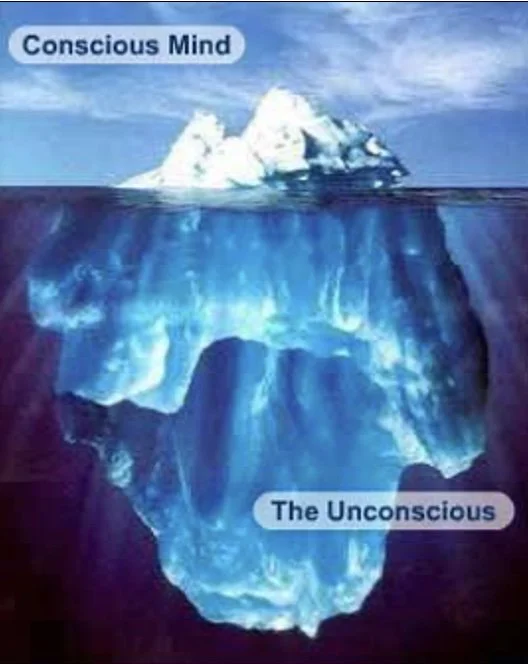
This is the difference in your mind. You are unaware of your unconscious mind, but it carries far more weight in what you choose by informing your conscious mind. Words and actions that you unconsciously say and do give clues to your deepest unthought and unspoken intentions. In the Theory of Unconscious Response™, we look at the system in the unconscious that maintains the energy of life in you.
As an organism, we follow nature’s system of self-renewal, similar to the way a fruit tree grows, produces fruit, and then repeats the process. The twelve phases system is an internal function much like that unseen internal function of a tree that makes it alive. From the beginning, the 12 Phases™ system repeats constantly, like a heartbeat. It maintains the totality of your person and automatically works to protect you as an individual.
I realize how incredible this sounds, that I was able to “watch” the progression through the internal unconscious and follow it out to an unconscious occurrence on the surface. It is a discovery made by a layperson, on her own, stating that this discovery is not yet found in scientific research. I write about it as fact because I believe it is factual. It is new scientific information, as yet unverified.
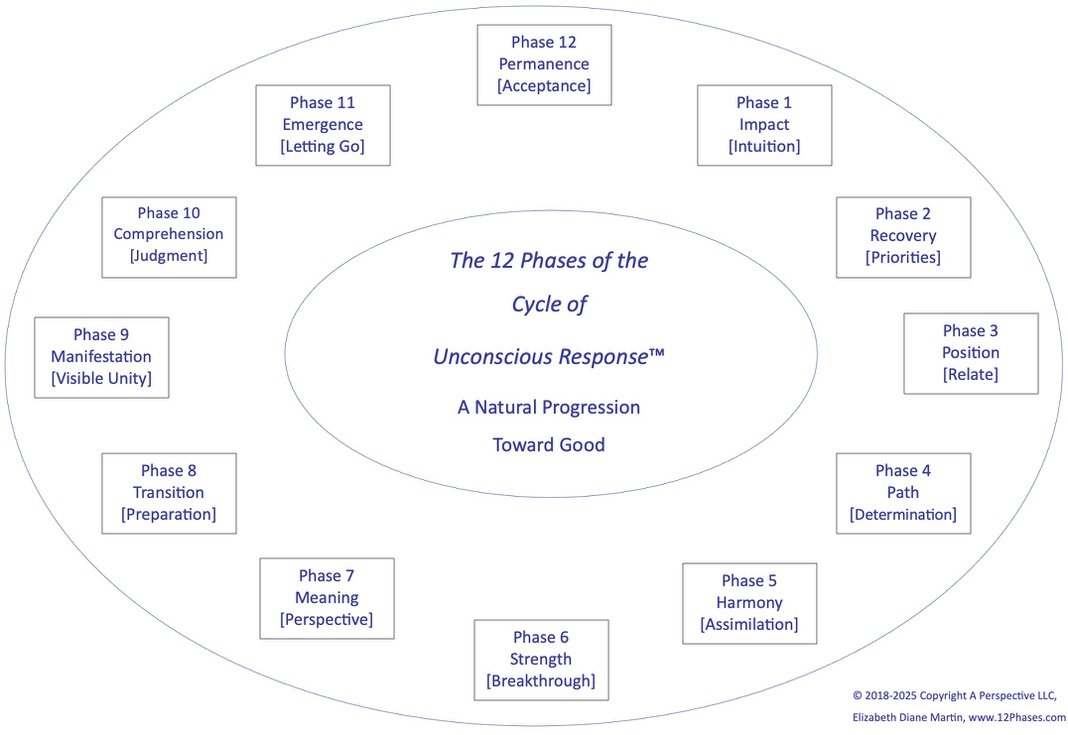
The 12 Phases™ of the Theory of Unconscious Response™
Phase One: Impact of an unexpected event.
• In a crisis, there is no conscious response because there is no available plan.
• Intuition creates a new path from the unconscious mind.
• A “seed” of good is planted and instantly begins to grow.
Phase Two: Recovery of autonomous direction.
• A personal priority system guides from the unconscious reservoir.
• Childhood impression of life
• Priorities formed by successes
• Autonomous motivation
Phase Three: Position formed from priorities.
• Relations with others led by personal choice.
• From autonomous motivation, you seek a safe place among others.
Phase Four: Path of Identity.
• A will to survive as an individual engages.
• A path is made to establish a place where you are acknowledged as an autonomous individual.
Phase Five: Harmony:
• Flow returns. The prior sense of control acquires the new information.
Phase Six: Strength
• The process results in a breakthrough.
• A new level of personal strength is achieved through the change.
The first six phases are the private internal processes to regain autonomy. The next six are the movement of life, taking you into your community where your new ability can be acquired. You are aware of a lack of strength, being a small part of a life-imposed reality. It’s not just about you; meaning is the greater objective of autonomy.
Phase Seven: Meaning. Life absorbs the new strengths through community.
• Autonomy is tempered by greater awareness of others.
• Others unconsciously acquire benefits from your strength.
• A new perspective aligns direction with the greater unconscious agenda.
Phase Eight: Transition. The internal view of the external is expanded.
• The forces of internal and external come together, raising new questions.
• Natural processes move you away from the known toward the unknown.
• In a pause, preparation strengthens ability.
Phase Nine: Manifestation of the new growth.
• The outcome is a natural result of the phases.
• Others see you among them, arriving in a new position.
• In a community, the outcome gives you a specific place.
Phase Ten: Comprehension: Irrefutable fact
• The physical, witnessed event becomes a fact in your history.
• Factual bases increase good judgment.
• Maturity comes in knowing and accepting the facts.
Phase Eleven: Emergence
• A new good replaces a former natural good.
• The process is eased by letting go of the former good.
Phase Twelve: Permanence of the New Good
• The seed of good from phase one is matured and irreversible.
• The authority of Good is in its permanence.
• Full, improved autonomy provides strength for the next level of growth.
• Acceptance occurs in having finished the process.
On occasion, you may recognize a few of these steps happening in your conscious experience. That is normal. What is remarkable is that the phases occur, unconsciously, from phase one through phase twelve.
The twelve phases constantly restore your sense of self-control. Many events are in operation at any point in your life so that you stay on top, just like a gyroscope stays upright, regardless of change at its base. What stays consistent is the fact that change stirs new growth in you.
How the Phases Feel
Transformation in Phases 1, 2, and 3:
A deep stirring awakens in me.
My mind looks into the movement.
A position toward the new thing is formed.
Energy in Phases 4, 5, and 6:
You orient outwardly from a new internal compass.
New life blends in, moving away from change.
A breakthrough to a new personal best.
Community in Phases 7, 8, and 9:
Life encompasses you to the benefit of others.
Perspective redirects attention, anticipating something new.
Witness the reality of growth, the fact of it materializes.
Authority, the finish in Phases 10, 11, and 12:
The order of life shifts around the product of growth.
Shed old comforts and adapt to how life has changed.
The work of growth is done; a new level of maturity is accomplished.
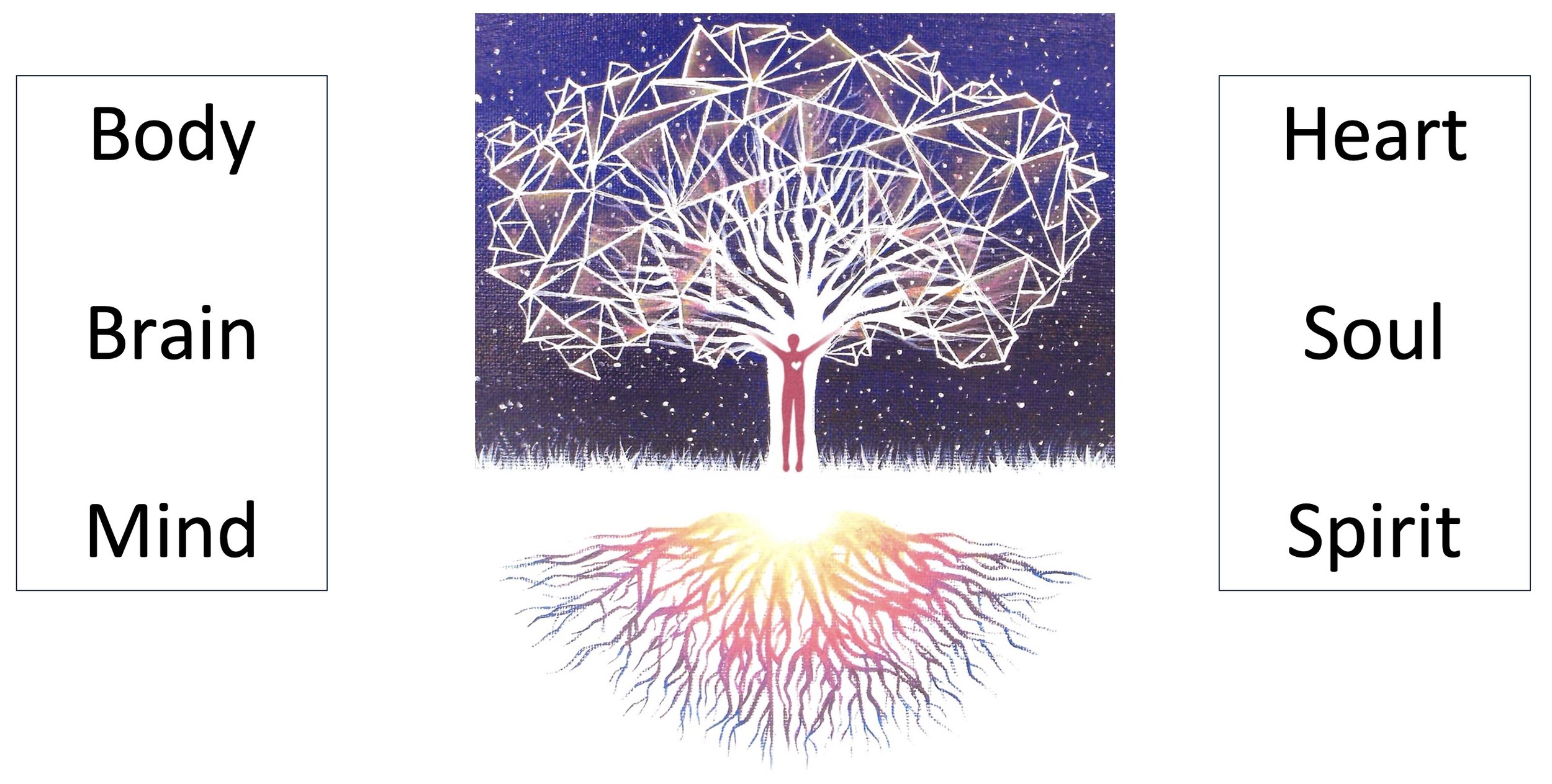
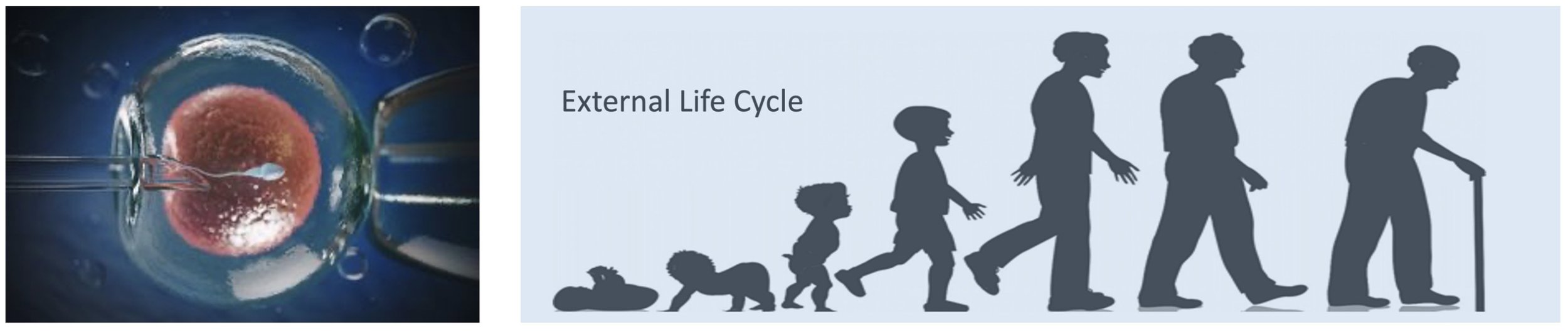
Change is Physical and Non-physical
Individuality
The Theory of Unconscious Response™ is a study of a new discovery: that you grow as a person in a regular pattern of twelve interconnected steps. Knowing how you are by the 12 Phases™ will help you know who you are – and where unexpected events allow you to choose, unconsciously, where you are heading in life.
In pre-birth, your DNA specifies who you are. When you are born, your solitary life cycle begins. Internally, you develop in all ways. The path of that development is unique to you. The 12 Phases™ system, based on the twelve phases phenomenon, counts the sequence of personal growth that is whole - it includes your organism and its responses to the external environment.
Your organism develops according to nature to move from babyhood to adulthood. In the 12 Phases™ system, the regular movements of development can be anticipated as natural growth, giving a firm regular basis under the changes life brings your way. Making a connection between your internal development and external events reveals the unconscious path you choose from childhood to adulthood.
Life is change; mapping the events of your history can reveal the hidden order.
Your life history can match external events with the phase of your development during your life cycle. This makes new information available to you – about how you are becoming who you are – by your unconscious responses to change in your life. Your unconscious responses are unique and identifiable as yours alone; you can see your timeline in a way that gives meaning and direction to your life.
I created this tool and have used with others to map significant events in their life history onto the 12 Phases™. The exercise indicates an order to their lives that they did not know was there. To see order uniquely described in your life history will transmit that order to your conscious mind. It is natural and understandable.
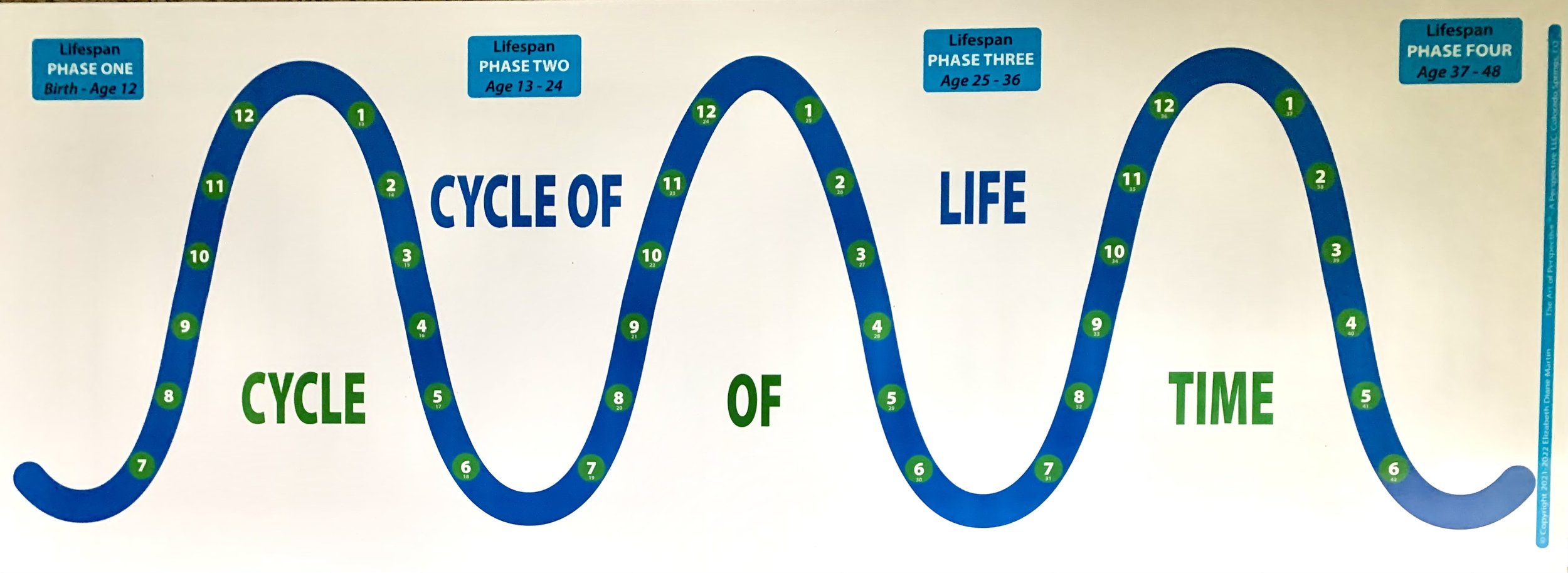
In observing yourself, awareness of a physical response in your body – the feeling – is the first evidence of the twelve phases phenomenon. A very dramatic response to the 12 Phases™ system was with a business man who, in our session, was able to identify the “glow” in his heart that excited him. Almost immediately, the realization became emotion in this man: he saw a solution to his current life problem. in the following months, he demonstrated the difference in his dynamic words and actions, unique and personal for him.
One woman experienced a fundamental shift out of self-doubt and low self-esteem when she realized the value she held in life, in the way she chose to live from her heart. This is something only the phases can show. Another person was in transition, retiring from the military at a young age and entering civilian life. For him, seeing his life history and its distinct direction gave him hope for the future.
In a few cases, the person was visibly upset about their life circumstances, showing it in emotional words and physical tensions. As I showed them the phases for their life, they became visibly calm and increasingly relaxed and open as the system unfolded for them. I only regret that my clients could not express their deep responses in words.
In a different example, one of my subjects was a 20-year-old woman whose life already had so much change that it seemed to be chaotic. She allowed me to plot her history onto the phases to show the order building in her life. In her early childhood, the family house burned down, her mother left to help her family during a period of deaths and was gone for two years, and her father failed to care for her adequately.
Her response was to turn away from the direction family circumstances had given her. First, she made a determined difference in her high school education by adding a college education. She then made a break from her family by moving far away. These early choices show a personal development motivated by all the troubles she did not cause. Her choices are building an unconscious priority system that will serve her as she matures.
The 12 Phases™ system reveals the unseen path of growth within your unique life experiences. With the 12 Phases™ system, your progress in the growth process can be seen; it shows the trend in a positive direction. In times of discouragement, this insight can help you see your experiences more clearly, making it possible to know how to approach decision-making with confidence.
You can take time now to reflect on your past and future growth by adding memories of significant events in different periods of your life. The following suggestions will help you connect how you think with how you develop and will develop. The situations you remember provide feelings that are personal and relevant to you.
Map Your Personal Development by Age
See how you exercise independent thought in your personal development:
• Think of the circumstances of your early childhood. How was it? What was important to you between age 10 and 12?
• Teenage years present opportunities to exercise autonomy, to choose from life what becomes important to your future. By age 20, you may have formed an idea of how life can be. What kinds of things became “must haves” or “will not have”?
• Between ages 25 and 36, relationship choices are evaluated against your unconsciously developed priority system. How do/did your priorities influence who you choose/chose? Did you end up in circumstances less than ideal that worked out or ended? Your experiences contribute to the yet unfinished development and understanding of life.
• From 36 to 48, maturity is reflected in what sticks with you and how you are able to make a place that is yours alone, where you feel emotionally safe. This takes some working out, bringing down or working around obstacles to be in a space that feels right. During this period, your natural strength really comes forward.
• From age 48 to 60, you find rest in knowing yourself and having made a place that suits you. Your life, as a whole, settles as a representation of who you are. Higher values become important, as you see them. Your headspace feels secure in all that you feel is you.
This natural course of development is implied by the 12 Phases™ of the Theory of Unconscious Response™. When you find the life phase you are in now, you can look at previous phases and see a reasonable connection, how you improved in the natural course of maturation. Taking a wider view of your life, and seeing the periods of advancement through managing unexpected life events, should settle some anxieties that come from not knowing what circumstances mean. Circumstances are temporary; development is steady.
Natural and Whole
The way growth happens in the human organism is the same for all of us. The organism maintains stability around the specifics of its person: you. Adding knowledge of the twelve phases phenomenon to our understanding of human development has the potential to raise our abilities to be more positive, to live in a way that life supports, giving us more insight into individual purpose. To feel more satisfied in your work because you honor your own deep, inborn, unconscious, and heartfelt desires.
The twelve movements are connected in the same sequence, no matter the circumstances. In the twelfth phase, a permanent change is accomplished, expanding the self with new knowledge that increases an accurate view of life. It is a natural progression in a good direction – “good” being to achieve a new level of personal maturity that benefits the person in a particular way.
The Theory of Unconscious Response™ explains the innate system that automatically preserves and protects your sense of self — your autonomous motivation — through developmental changes. Any disruption to the normal state of self-regulation is instantly managed so that your whole organism benefits from the disruption, and the normal state of self-control is restored.
IN LIGHT OF SCIENCE
My study of unconscious response began with internal observations. I was journaling at the time and found that, looking back on my notes, I saw shifts in attitude. I realized that I could not deny the hopeful and positive days, even though I might have been in a negative attitude when I read them. This prepared me for observing my feelings and self-observations regarding the phases.
My curiosity prompted a switch to using what I knew about the scientific method. As I applied the method, I became more objective about what I saw. The steps are simple, but not easy:
1. Make observations
2. Ask questions, such as what kind of pattern is it and when does it occur?
3. Form a hypothesis: What do I think is happening?
a. A repeating three-step pattern rose above the circumstantial details: an unexpected impact, recovery and evaluation, and then internal positioning toward the situation.
4. Test
a. Identify singular characteristics of each phase and how they differed from each other.
b. In new circumstances, in retrospect, separate the external details from the internal movements.
c. See if the three-step pattern stayed the same in different situations.
i. The Impact of the Unexpected: When something unexpected occurs—whether meeting someone new or experiencing a radical change in a familiar relationship—it often triggers a visceral gut reaction. Because these events fall outside of my expectations, a survival mode engages where my responses, such as freezing or showing sudden emotion, are instinctive reflexes rather than deliberate choices.
ii. Recovery and Evaluation: Following that initial impulse, I move into a stage of intellectual calm to restore internal order. I sort through these experiences by asking myself what happened, why I reacted as I did, and whether my behavior aligned with my personal values. This evaluation helps me isolate the dynamics of new situations and reveals personal priorities and an internal compass that naturally draws me toward stability.
iii. Internal Positioning: Once I processed the situation, was I able to establish a perspective of my own that is separate from the external impact. This allows me to make internal determinations about where I can safely and authentically reside.
By making these intentional yet unconscious choices, I saw how I found a way to move beyond mechanical living toward a life of greater fullness and meaning.
5. Develop testable predictions
a. In retrospect, can the three-step pattern be recognized as separate from the circumstances?
b. Are there internal prejudices affecting the quality of observations?
6. Gather data: Continue to test over a long period of time, at least several months.
7. Refine, alter, expand, or reject. Separating the three-pattern internal movements from the external factors raised some questions about my bias. Observations of this internal reflex must be tested with an intention to exclude personal and cultural bias. I established specific criteria in these areas:
a. Gender. This was a study of the innate spark of human motivation, not based in anatomy, physiology, or any lifestyle that could be identified as springing from anatomy, physiology, or lifestyle.
b. Nationality. I had been separated from the homeland for over a year and lived off the tourist track on one that skimmed over the top of the Thai culture. This broke the continuity I had in Colorado and I returned with a kind of objectivity about American culture as a whole. The nature of people in common is being human.
c. Age. I found a basis of common identity and simple human affinity, regardless of age. As a parent and grandparent, I found it impossible to connect with a child’s broken heart and maintain discipline using an authoritarian manner. Necessity demanded deeper communication to understand a child’s unique form of grief. I found the same emotional and physical reflexes in children as I have as an adult: the aching in the gut while crying, for example. Children do not yet have words for grief. While the study went forward, it became extraordinarily important to encourage love and each one’s desire to be part of a family unit. In a highly emotional and unhappy circumstance, we had to find the highest and best natural motivation for each of us.
d. Spirituality versus religious doctrine. Aside from the personal faith I retained, the search for spontaneous positive motivation was quasi-science so I learned to separate natural spirituality from my own self-serving doctrines. My search was increasingly focused on the natural human phenomenon. Even if a spiritual principle is understood in various forms of mysticism, I wanted to express what I found about the heart and spirit in my native Western logic and language. In other words, if this is an observable natural phenomenon of human nature, it was not necessary to use labels adopted from Eastern or Western cultures and language.
8. Gather more data: Continue to test with these criteria so results are more objective.
9. Again, refine, alter, expand, or reject biases.
Several years of continued observing and testing led to a discovery of the complete phenomenon that I call "12 Phases of the Cycle of Unconscious Response™.” This experience is in my book, The Heart's Mind: How Unconscious Responses in Life and Work Naturally Improve Our Lives While We Make Other Plans (2018).
Making a “Footprint”
In 2019, a client introduced me to Debra J. Dean, PhD, a dissertation coach. She was the first person to recognize the scientific discipline in my book. Debra agreed to work with me to publish an academic paper about the phases. In 2020, with Debra’s excellent coaching, we published the paper “Qualitative Study of the Theory of Unconscious Response™.”
This was a huge accomplishment for me, stepping boldly into the realm of peer review. It set me on an exciting new path: finding more work among scientists that might validate my discovery.
Science Works
In the “Qualitative Study of the Theory of Unconscious Response™,” I leaned on two major principles:
1. Albert Einstein’s theory of special relativity:
Relativity changed all research and reaches into our everyday lives. According to special relativity, no two people have the same perspective on events, even if the events are experiences at the same time. This special position is in the physical space a person occupies, which no other person shares.
Einstein’s work was simple and profound. Over a century later, scientists are still working through how general relativity changes the classic understanding of physics. In this study, special relativity and general relativity, with respect to quantum space, give clear definition to the singular space of one human.
The Theory of Unconscious Response™ explores the nonconscious activity within humans that sustains autonomous motivation. Autonomy is implied in special relativity: one person, one perspective. The study of unconscious responses is connected to the epigenetic processes at work in the organism, from the physical to the mental.
Autonomous motivation is a mind-and-body process that originates in the unseen power behind movement. In unconscious responses are the clues to the particular way autonomy is maintained in life. For each person, meaning is contained in their internal response to the interaction in an experience. New experiences – new decisions – are connected to a person’s history in a unique way.
In the Theory of Unconscious Response™, meaning is hidden beneath external circumstances. By mapping a person’s life history, changes in direction are revealed in the spontaneous, unplanned movements. The history of these unplanned movements shows an unconsciously held priority in autonomous motivation.
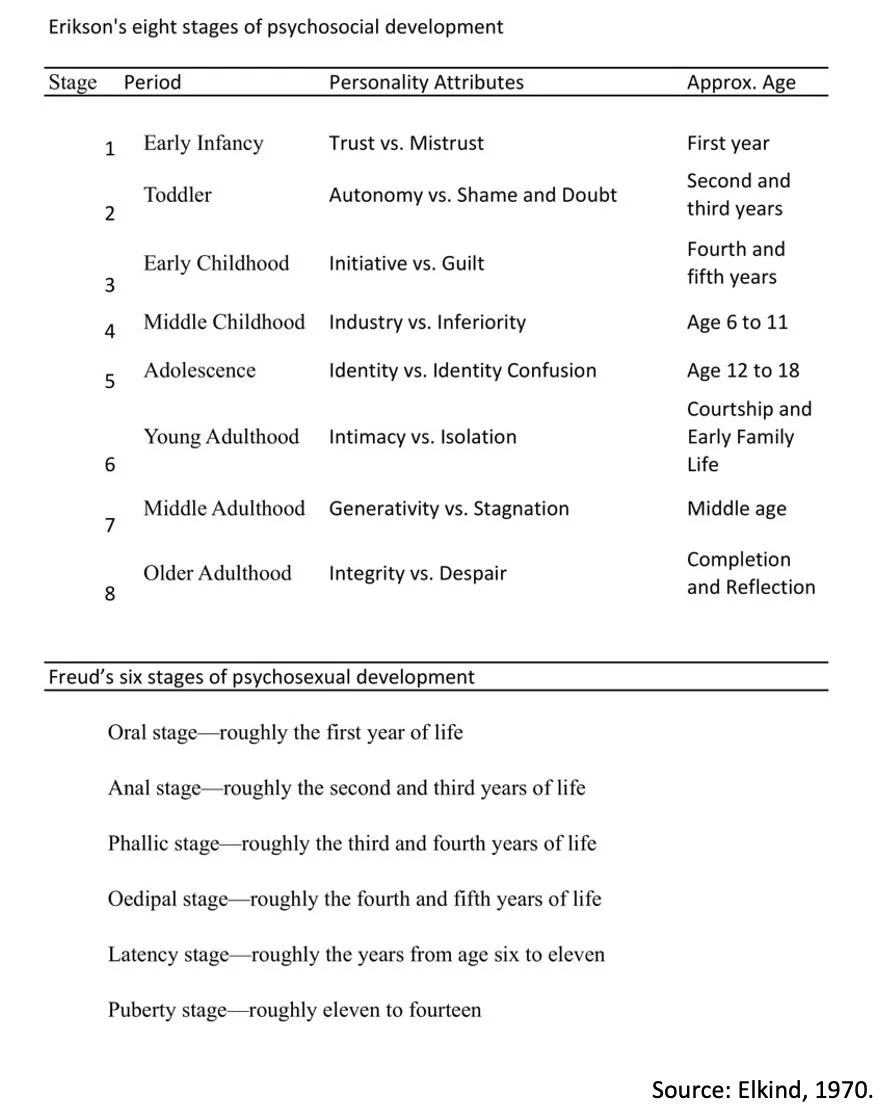
2. Psychologist Erik H. Erikson’s Epigenetic Model of Human Development:
Erik H. Erikson was trained by Sigmund Freud and turned psychology toward positive alternatives in development. Erikson applied the “organismic principle of epigenesis” to the whole life span. This study rests upon this key principle and the “wholeness” in Erikson’s way of looking at the life cycle. (Erikson, 1997, p. 26-27) Erikson states that this important model, taken from the discoveries in embryology at that time, was critical to his understanding of organic unity of the whole life cycle.
New Connections in Science
In talking about my research into unconscious behavior, the Lex Fridman podcast was recommended to me as a resource. During the two years I followed Fridman closely, he interviewed many scientists and philosophers in his search to understand what is essentially human. As a robotics developer, he aimed to make robots more humanlike.
Those fascinating talks, unscripted and lengthy, exposed the lives, culture, and work ethic of scientists in different fields of study. As I recognized a similarity between my way of living and working in theirs, my credibility got an unexpected boost.
A. Theoretical physicist Fay Dowker, in her address to the philosophy department in Geneva (https://youtu.be/LAFymPdAg5I). In demonstrating the effect of general relativity on scientific thought, Professor Dowker gave me four major points that encompassed my work:
a. Time can only be measured in the experience of each entity in spacetime, whether a star, a planet, or a person.
b. The historic events comprise the “worldline” of each entity; these events are only fixed in the history of the entity. I was showing people how the life cycle phases worked in each individual life, based on their life history.
c. The only way to know the timeline of an entity is for those events to be plotted on the worldline.
d. “Becoming” versus “being” as her chosen perspective on her work. This pertains to the epigenetic unfolding of an individual, as I have used as a foundation of the Theory of Unconscious Response™.
Professor Dowker’s ending statement encouraged me in continuing my work:
“We shouldn’t limit ourselves to any particular tradition of thought but look most widely at all of human thought to give ourselves the best chance of making progress in the future.”
My work fell into the way she, as an authority, embraced “all of human thought” as applicable to her scientific research.
B. Neuroscientist Antonio Damasio: Feelings are representations of the state of your body. In this book The Strange Order of Things: Life, Feeling, and the Making of Cultures (2018), esteemed neuroscientist Antonio Damasio explains much of the internal, physiological, and mental processes as a whole-body process. Damasio makes extensive intricate descriptions of the body-and-mind organism and how the process delivers images to the human mind.
Thanks to Damasio’s life of research and advancements in neuroscience, we now know how the body and mind work as a fluid system. His understanding has mapped this complex system as the way your organism works smoothly, giving you the ability to create solutions to your problems as a way to improve your life. (The Strange Order of Things, 2018). Using homeostasis as the core principle, Damasio states:
Homeostasis refers to the fundamental set of operations at the core of life… Homeostasis is the powerful, unthought, unspoken imperative…nothing less than enduring and prevailing…ensures that life is regulated within a range that is not just compatible with survival but also conducive to flourishing, a projection of life into the future of an organism or a species. (Damasio, 2018, p. 25)
The term “flourishing” aligns with what humans perceive as “good.” As organisms operating with the physical imperative of homeostasis, Damasio shows clearly how the nervous system and the body system work with the brain to deliver messages to the mind. In images sent to the mind, the whole body reports what your condition is.
The collection of coordinated processes required to execute life’s unthought and unwilling desire to persist and advance into the future, through thick and thin, is known as homeostasis. (p.34)
Damasio’s book successfully depicts the body-and-mind organism to show the living, fluid system we enjoy. Where Damasio’s conclusions jump forward to the advances in society, the Theory of Unconscious Response™ may fill the gap by showing how individuals advance, maintain personal authority, and contribute to societal growth by creating, thereby increasing good for everyone.
This natural tendency to move in a positive direction is true for the complex human organism just as it is for single-celled bacteria. The individual perception of a positive direction highlights the singular perspective in self-regulation. Every cycle of 12 moved me forward – my organism looked after its own (my) good.
Damasio’s specific descriptions give weight to what I have observed in the twelve phases phenomenon. As an inherent process in our organism, the integration between body and mind is in what matters to you:
…When feelings, which describe the inner state of life now, are “placed” or even “located” within the current perspective of the whole organism, subjectivity emerges. And from there on, the events that surround us, the events in which we participate, and the memories we recall are given a novel possibility: they can actually matter to us; they can affect the course of our lives… (p. 158)
Damasio’s neurobiological model shows that the mind and body are not separate systems but one organism, constantly working to preserve itself. So autonomically constant is this activity that your awareness is transferred to the external experience. Unconscious behavior aligns with inner meaning before we’re aware it’s happening. The internal system that has its own lifelong agenda: making you, you! Every cycle of 12 moves you forward – “upregulates” you, a term Damasio uses for the nature of organisms to seek their own good.
C. Assembly Theory: Chemist Lee Cronin and theoretical physicist Sara Imari Walker rose to prominence in the Lex Fridman podcast conversations about the search for life on other planets. Their “assembly theory” came about in a search for the origin of life as a way to recognize unfamiliar life forms on other planets. Assembly Theory came out of the hunt for ways to detect extraterrestrial life forms. The question is, how can we recognize life that may be in a form we don't recognize?
Assembly Theory (AT) proposes that the first steps of life systems can be identified before they produce a product. The theory has a system that finds the first, most simple chemical bonds that begin a life-forming process. The theory asserts that complexity and memory are evidence that life forms by assembling components through time, retaining what works, and discarding what doesn’t.
a. Assembly theory focuses on the specific signs of life systems, regardless of the form of the object. These are traits of the assembly space in AT:
i. Intrinsic: a characteristic defined by its formation history.
ii. Recursive: “retains the memory of past formations of objects”
iii. The object’s building blocks are measurable.
iv. New objects are available for subsequent steps.
v. Organisms and environment are “co-constructed and co-selected.”
vi. The precise assembly path leads to the object.
vii. “an explicit arrow of time intrinsic to the structure of assembly spaces”
viii. “objects can only be built from parts that already exist…therefore historically contingent.”
(That same principle appears in human development as our organism selects from disruption what works for the individual in the epigenesis of a unique person. The 12 Phases™ show how our internal responses select, refine, and reintegrate experiences into new structures of the self. The evidence of life is in its beginnings, how an individual exists according to their DNA. The “product” of the process is shown in the evidence of unconscious response but the process is the life-giving structure.)
b. In her book Life as No One Knows It: The Physics of Life's Emergence, Sara Walker suggests that new laws of physics are needed "...that include us as part of the system we are studying..." She says further:
“…We cannot see ourselves clearly because we have not built a theory of physics that treats observers as inside the universe they are describing…explanatory power for how we think about and interact with the reality in which we alive…”
and
“…Life exists in biology and technology as far as we know, but we do not understand the transition or continuation of life from biology to technology, any more than we understand the continuation of life when chemistry transitions to biology…”
c. Sara Walker aims to find out what makes matter alive. This is where she and Lee Cronin come together in assembly theory. Sara considers the assembly index an intrinsic property of a molecule, essential to using the theory for solving the origin of life, as well as time being fundamental in making bonds in a series of steps, something like an algorithm. In that way, she says, information is also an object.
The twelve phases phenomenon of human development meets many of AT criteria. It is:
a. An intrinsic, self-organizing system.
b. Recursive: the same twelve phases repeat cyclically to build. At Phase 12, the new growth is available to reproduce growth in the next cycle.
c. 12 is the “minimal number of recursive steps necessary to build the object.”
d. Each phase is separable as a principle and is interdependent in the system.
e. The human organism responds to activity around it in rebuilding autonomy, and through autonomy the individual affects its environment, the surrounding community.
f. The system of 12 interdependent and sequential elements that leads to the formation of new growth in the individual. The end of the “assembly path” is perceived as a new good in human experience.
g. Time is distinct; its factors historic in unchangeable events plotted along the individual’s worldline (Dowker).
h. Natural epigenesis occurs in the womb, it carries forward at birth, and continues and regenerates throughout the life cycle until the person dies.
The twelve phases phenomenon is a sign of life, literally the origin of development in each individual. The direct connection between humans and the steps of advancements can be shown through the twelve phases phenomenon. It addresses the need for more information about ourselves as life on this planet, not yet fully understood. In the mandate of homeostasis, the twelve phases phenomenon constantly makes progress on the worldline of an individual. (Damasio; Dowker)
This new information in the twelve phases phenomenon can define the origin of life on Earth as residing in each individual person. The proof of life is in the autonomous movement within the body-and-mind organism. The twelve phases phenomenon is an intrinsic trait of humans that precedes what we create – societies, technology, the arts, and all the visible evidence of advancements in our history.
From quantum physics to individual worldlines, from chemistry and epigenetic biology to Damasio's extensively described body-and-mind organism – from the images the body sends to the mind, to the person who addresses that information by creating custom solutions – this is the most complete understanding of human experience. The twelve phases phenomenon is key in connecting the physical human to how a person functions in life. It is the minimal number of steps, the place where new constructions originate, that identify humans as the highest order of life on Earth. Each person is one cell in the whole of humanity. Every organism sustains itself and affects its environment.
The principle of epigenesis in the human organism is shown in the twelve phases phenomenon. The distinctly inimitable individual revealed at birth develops according to inborn abilities and disposition. Birth demands a response to the impact of an environment completely different from the one the baby left. Epigenesis – the continuous unfolding from the beginning – happens in the baby and through the years of learning the conditions of their life. The automatic responses of the baby and as a young child come from those inborn traits; they are the inherent resources available to the child as a distinct person.
The twelve phases phenomenon is observable as an intrinsically built system that preserves and protects the autonomous nature of each person. By following the twelve phases from birth through the whole life cycle over the human lifespan, the 12 Phases™ structure is a tool for gauging the progress of an individual in their personal development. What makes the information meaningful is the personal history of life events.
You as an Organism
In much research, writing, and teaching, neuroscientist Antonio Damasio speaks of the whole body and mind system as one organism. In his books, he shows how the human organism behaves as any organism does, compelled to survive. This nonconscious activity is called homeostasis, he says, an undeterred life-controlling mechanism that urges the organism to “upregulate” – not only to survive but to thrive.
Professor Damasio describes the separations in the big picture – the organism and its environment. What happens in the organism is completely separate from what is experienced externally. This applies to humans. What happens in the interior of your organism is the effect, physically, of the external environment on your organism.
Damasio has mapped the complete paths of the body, brain, and nervous system that deliver images to the mind. The body-mind organism, he says, sends messages to the mind about the state of the body. If there is a problem, homeostasis demands a solution.
For each person, the condition reported causes them to address the problem. For example, hunger in the body makes you look for food. An illness sends you on a hunt for relief. The solution comes from your particular set of resources, including your ability to create a solution. If the situation is life-threatening, you may turn all your efforts toward a solution.
Finding Solutions to Your Problems
The Theory of Unconscious Response™ is a study of individual inner experience and how nature allows you to find a custom solution for your needs. As the effect of the twelve phases phenomenon moves through your inner environment, these impulses build a bridge between your inner self and the external world. The unique combination of internal and external experiences is forming an individual path of development.
Beginning at birth, how you are, in disposition and abilities, is you reaching into the external, making a being that increasingly matures over your whole life. This is a natural course of an organism; it is the natural power of growth. Your distinction from every other person in all the world comes out of your internal nonconscious development into your choices. The twelve phases phenomenon describes that process.
The path of development, from your DNA’s physical characteristics and your disposition, is contained in the history of your life experiences. By looking back at how you have responded to unexpected events, we can see consistent patterns that reveal who you are and what truly motivates you beneath conscious thought.
Your history lies in retrospect. Only by looking back over your life experiences can you see what is true about you, what direction you consistently choose, unconsciously. The Theory of Unconscious Response™ is about the system that maintains you in your hidden autonomy. This book presents the history of the theory as it was observed, refined, and tested through real human experience.
My original discovery was a result of an obsession. What was it about life that dragged me with it, even against my consciously generated opposition? By watching my inner responses, I was able to separate the routine, conscious acts of necessity – working to pay bills, shopping for groceries, cooking, eating, and sleeping. This repetitive cycle could be performed without any observable good. It was surviving, having no inspired choice.
When unconscious response showed a life force, I looked for more of it. Months passed between the first and second occasions. To speak without forethought, or to run away without explanation, showed energy moving through my body.
Observing over months and years, using the scientific method to test my conclusions (2018), the consistency rose as the situations passed. The twelve phases are a natural phenomenon, systematically at work in me. No one else has seen the same experience within themselves – yet. As an unverified theory, scientific proof is a long way off. I can only report it as I discovered it and as using it to help others continues to prove itself to me.
Those who meditate are trying to get to that place of peace I found, a reality away from the busyness of life. Science doubts there can be a valid test of subjective experience, but it can be proven in your experience. Neuroscientist Antonio Damasio often writes about the experience in the organism. Here, he addresses the problem of scientific validation:
This may cause some worry to purists raised on the idea that what another person cannot see is not to be trusted scientifically, but it really should not worry anyone. This state of affairs should not prevent us from treating subjective phenomena scientifically. Whether one likes it or not, all the contents in our minds are subjective and the power of science comes from its ability to verify objectively the consistency of many individual subjectivities. Consciousness happens in the interior of an organism rather than in public, but it is associated with a number of public manifestations. Those manifestations do not describe the internal process in the same direct way that a spoken sentence translates a thought, yet there they are, available to observation, as correlates and telltale signs of the presence of consciousness.
Based on what we know about private human minds and on what we know and can observe of human behavior, it is possible to establish a three-way link among: (1) certain external manifestations, e.g., wakefulness, background emotions, attention, specific behaviors; (2) the corresponding internal manifestations of the human being having those behaviors as reported by that human being; and (3) the internal manifestations that we, as observers, can verify in ourselves when we are in circumstances equivalent to those of the observed individual. This three-way linkage authorizes us to make reasonable inferences about human private states based on external behavior. The solution of the method problem posed by the privacy of consciousness relies on a natural human ability, that of theorizing constantly about the state of mind of others from observations of behaviors, reports of mental states, and counterchecking of their correspondences, given one's own comparable experiences.
(Antonio Damasio, The Feeling of What Happens: Body and Emotion in the Making of Consciousness.)
No language existed for what I experienced. As I shared what I learned, I struggled to find words that others could recognize. I created diagrams and tools to show the system visually. I mistakenly expected my description to catch others’ curiosity the way it captured mine. All the work and writing I have done only accomplished one thing: I can demonstrate the existence of the twelve phases phenomenon and how it works. In other words, I can only say what it is.
Meaning in the Theory of Unconscious Response™
The Theory of Unconscious Response™ describes the twelve phases as an inherent self-maintaining system that operates like an organ, without conscious influence or control. Therefore, unconscious responses come directly from this unseen, unknown inner maintenance routine. The system is always operating, keeping you motivated – energized – to see and do, from your core, what aligns with your particular “personhood”– what is increasingly becoming more of you.
The 12 Phases of the Cycle of Unconscious Response™ (the 12 Phases™) is a model based on observations and testing, a system of repeating phases that constantly operate to keep you upright in your core, especially when your world is disrupted by unexpected life events. At the moment of disruption, the system that is you, as an organism, steps up instantly because the unexpected freezes the conscious mind. Your organism behaves to protect and preserve your person, your autonomy, and the way you behave unconsciously tells the story of your organism’s agenda.
In the big picture, what you do and the way that you do things matches your core motivation. Your organism, like any other organism, does what is necessary to stay alive, but for humans, thriving means having purpose, to improve our circumstances. We each have an unconscious drive for our life to have meaning, not just to fit into the ruts of all that life demands in human society. The Theory of Unconscious Response™ indicates that meaning is at the core of human survival.
There are two dynamics in the 12 Phases™:
1. First is the operating principle that is the self-organizing operation of the phase. The operating principle functions on its own to lead toward growth. This is the independent operation that is accomplishing one of the 12 interdependent phases, such as the spontaneous appearance of unconscious response in a crisis. This response comes from the self-organization that happens, detached from the circumstances. The shock is temporary; intuition guides you without the conscious mind’s usual leading.
2. Second is how the unconscious response I observed seemed typical. The response was an experience, using my own discovery about the sensations I experienced during each phase. The experience of the operating principle in our bodies and in our minds is unconscious. The simultaneous occurrence – your response to the principle at work – keeps your organism on track with your autonomous motivation – what it takes to be you.
Testing the keywords satisfied me, that together the keywords indicated movement and the unconscious experience of development. See the flow of each:
Positive Direction implied in the Sequence of Keywords
The Operating Principles Respond to Disruption:
Impact > Recovery > Position > Path > Harmony > Strength > Meaning > Transition > Manifestation > Comprehension > Emergence > Permanence
Typical Unconscious Responses indicate the Growing Effect of Each Phase:
Intuition > Priorities > Relate > Determination > Assimilation > Breakthrough > Perspective > Preparation > Visible Unity > Judgment > Letting Go > Acceptance
From the first phase to the twelfth, the 12 Phases™ system is a process of human development. The importance to you, and to each of us, is in the meaning of our lives. Meaning fuels autonomous motivation. The Theory of Unconscious Response™ sets forth the whole self-culture that is distinct, individually. Biology describes how human bodies are sustained by nature, and the 12 Phases™ system describes how autonomy is sustained by nature.
The product of a system often indicates the purpose and value of the system. I came to believe that the repeating sequence reflects a fundamental process within human nature: an unconscious system that guides us toward growth, adaptation, and the gradual expansion of what we experience as good.
Conclusion
This is a science of how we return to ourselves.
This work focuses on something very specific:
1. How human autonomy reorganizes itself after disruption.
The cycle begins with impact and recovery, then moves toward position, path, and meaning, and eventually toward integration and permanence. That sequence describes how a person regains self-direction.
When I map a person’s experiences onto the 12 phases, it helps them see that:
· their struggles were part of a developmental movement, not random failures
· transitions and crises have a place in a larger process
· their life shows continuity over time
That kind of structure can naturally produce calm. This isn’t a theory about how people should change. It’s a discovery of how they already do.
2. The 12 Phases™ Model Restores a Sense of Direction
People often feel distress when they believe events are chaotic or meaningless.
The twelve-phase framework implicitly says: “You are somewhere in a process that has movement.” Even if you cannot articulate the theory, you sense that your experience fits within a pattern. The mapping exercise provides a way you can see your life as a developmental journey rather than isolated events.
3. The Phases Normalize Difficult Experiences
Another calming effect may come from normalization. For example, if someone recognizes that a period of conflict or uncertainty corresponds to a developmental phase, they may feel:
less self-blame
less confusion
more patience with the process.
Instead of thinking “something is wrong with me,” they might think “this is part of a growth transition.” That shift can be surprisingly powerful emotionally.
4. This Method Encourages Self-Recognition Rather Than Advice
The insight is not imposed by me. Instead, the participant recognizes their own experience within the structure. That kind of recognition tends to be more convincing and more comforting than external interpretation.
References
Elizabeth Diane (2012/updated 2019) Time and Life Cycles: The spirit’s journey through time.
Elizabeth Diane (2018) The Heart’s Mind: How Unconscious Responses in Life and Work Naturally Improve Our Lives While We Make Other Plans.
Elizabeth Diane with Dean, D. J., PhD. (2020) “Qualitative Study of the Theory of Unconscious Response™.”
Damasio, Antonio (2000) The Feeling of What Happens; (2005) Descartes’ Error; (2018) The Strange Order of Things: Life, Feeling, and the Making of Culture.
Dowker, Fay (2019) in her address to the philosophy department in Geneva (https://youtu.be/LAFymPdAg5I).
Elkind, D. (1970). One man in his time plays many psychosocial parts. The New York Times Magazine, April 5, 1970.
Erikson, E. The Life Cycle Completed (1982) and The Life Cycle Completed, Extended Version with New Chapters on the Ninth Stage of Development by Joan M. Erikson (1997).
Erikson, Erik H. (1950, second edition 1963). Childhood and Society.
Erikson, Erik H. (1959, second edition 1980). Identity and the Life Cycle.
Erikson, Erik H. (1964) Video interview with Richard I. Evans, Professor of Psychology, University of Houston video, interview with Erik Erikson.
Erikson, Erik H., edited by Schlein, S. (1987). Erik Erikson ~ A Way of Looking at Things: Selected Papers from 1930 to 1980
Walker, Sara Imari, (2024) Life as No One Knows It: The Physics of Life's Emergence.
Zittoun, T., Valsiner, J., Vedeler, D., Salgado, J., Gonçalves M., and Ferring, D. (2013). Human Development in the Life Course: Melodies of Living.
ADDENDUM A
KEY EXCERPTS FROM THE STUDY PAPER:
“Qualitative Study of the Theory of Unconscious Response™”
by Elizabeth Diane, with Debra J. Dean, PhD. (2020)
Application of the Principle of Epigenesis
Current research in genetics looks toward manipulating genes for specific outcomes, such as removing a gene that would develop into a birth defect. Popularity of this work leaves behind the originating system. Unlike the term “epigenetic,” as used in current research, the principle of “epigenesis” is a first principle in the natural development of a unique person.
The epigenetic principle lies beneath all the intricacies of living things, where all stages or phases of development are seamlessly interconnected to accomplish the intended result. The function of any natural phenomenon can be studied where epigenesis is detected. In the study of the formation of identity, Erikson’s example leads our exploration into the phenomenon of unconscious response...
The survival of individual identity depends on autonomy and a natural autonomous flow among the intellectual, emotional, physical, and spiritual aspects of the whole person. Autonomy is the solitary internal human experience and a process intrinsic in human nature, a self-renewing process that ensures the survival of unique identity in each individual. Unconscious response indicates manifestations of this automatic process during the life cycle… The development and maturation of identity occurs as a naturally independent and self-organizing function beyond the physical, intellectual, and emotional experience of a person.
Using the 12 phases of The Cycle of Unconscious Response™, a person’s life experiences in the unfolding of her or his life span can be reviewed as a whole to explore such questions as:
• What is the singular view from within for one person, and how can we quantify it?
• How do a person’s worldview, experience, hopes, competence, education, and capacity to love create unique perspective?
• What is the inner source of productive vitality—what Erikson refers to as “generativity”?
• How is generativity renewed to endure over the whole life cycle?
• Is the 12 Phases of The Cycle of Unconscious Response™ model designed according to the organismic principle of epigenesis, and can it help us understand the separate experiences of individuals?
…In the present study, we propose a way to observe epigenesis at work in particular individuals over the course of each life span. The proposition is that human nature provides for systematic regeneration of positive motivation—the drive to initiate according to an isolated and intuitive interpretation of the meaning of life.
THE CYCLE OF UNCONSCIOUS RESPONSE™ MODEL
Over a period of sixteen years, from 1996 to 2011, Elizabeth Diane recorded her inmost soul-searching, a journey that revealed what appeared to be a deep-rooted, instinctive phenomenon. In dispassionate hindsight, she would review the disconnected descriptions of emotional flares, unvarnished thoughts, brief incidents, prayers, and reflections. Retrospection raised her to a position of evaluator of her own history. Like a message buried within a movie plot, the activity of life receded, leaving scattered pieces of life truths that, when connected, formed an order all its own. And just as the events of a story are a unique progression to encode parts of that message, pieces from the journals spoke something deeper by way of her life story.
Having no existing language for this phenomenon, Elizabeth Diane described the unfolding sequence she witnessed as honestly as she could. After years of attention to her intuitive responses in situations, having documentation in journals, and by constantly reflecting, testing and correcting in the scientific method, she developed a sense of direction, following the rhythm beneath the passing of time and the cycles of life. This pursuit gave value to her life, a new internal compass that renewed confidence in an ability to navigate change without losing this intrinsic sense of direction. (p. 18)
Elizabeth Diane, from the introduction to the 2019 edition of Time and Life Cycles: The spirit’s journey through time(original, 2012):
I reported on phenomena I observed and recorded over several years’ time, between 1997 and 2011—cycles of time, and of patterns in the subconscious life that coincide with time.
It was an on-the-spot record of my actual responses and feelings. In the way a technician observes reactions in a lab experiment, I was recording thought mechanisms built in my nature. I was watching my deepest heart in action…the first description of the very fibers of what I am. This study enabled me to fully recover my natural self in an age of computers and the virtual reality. I found a greater capacity to be truly human.
Also in the booklet was a day-by-day application of the system using calendar dates to show the continual self-organizing way initiative increased. In the revised edition, Elizabeth Diane added impressions; keywords to aid the reader in detecting the unconscious responses evidenced in the movement of growth…
In her book, The Heart’s Mind: How Unconscious Responses in Life and Work Naturally Improve Our Lives While We Make Other Plans, Elizabeth Diane (2018) recalls the first steps in identifying her spontaneous initiative:
- Impacted by something unplanned or unexpected, I reacted impulsively and suppressed feelings were exposed (Phase One of The Cycle of Unconscious Response™).
- To maintain my composure, I subdued the raw reaction and its exposure where I could manage my behavior from an abiding sense of what is right and proper, according my private standards (Phase Two of The Cycle of Unconscious Response™).
- From a position of calm, I would adjust my outlook and decide how I could handle the new situation appropriately. Where people were involved, I decided what my attitude toward them would be (Phase Three of The Cycle of Unconscious Response™).
From this initial pattern, the natural beginning, subsequent phases comprised a natural unfolding in the organismic principle of epigenesis. The whole 12 phase cycle revealed a progression toward improved life circumstances, an unconscious inclination toward good. The 12 phases of The Cycle of Unconscious Response™model represents the observed phenomenon of will, apart from intention and conscious formation and intuitive compliance with the constraints of time and fluctuations in life circumstances. In this continually expanding and maturing internal process, identity results from a self-organization that makes that person distinct from any other. This natural, intuitive, self-renewing ability to recover from unsettling changes assures an uninterrupted path of growth and maturity in the self over the span of a human lifetime…
The presence and progressive nature of the path of motivation, from intrinsic root to extrinsic manifestation, is illustrated in the 12 phases of The Cycle of Unconscious Response™.
The baby arrives equipped with unique abilities and personal traits that are the undeveloped roots of identity. From birth to death, the formation of identity is a continuous process of maturation over the life of each individual. The future of life for that person cannot be foreseen, but in reviewing occasions of the spontaneous assertion of will in the twists and turns of the physical reality, the path and direction of autonomy may indicate identity.
More meaning is explored in Human Development in the Life Course as self-organization proceeds from epigenesis:
Simply summarized, emergence means that the whole is more than the sum of its parts: Emergence . . . refers to the arising of novel and coherent structures, patterns, and properties during the process of self-organization in complex systems. Thanks to emergence, lower levels of self-organization produce higher level properties, which may, in turn be elements in higher-level systems. (Zittoun, et al, 2013, p. 14-15)
In the present proposed study, prior observations over an extended period of time (Elizabeth Diane, 2018) have revealed this natural phenomenon: A particular person forms a private self-culture out of the collective life experiences, and this self-culture is the core matrix from which personal drive is formed. It is a living, intuitive, and unconscious self-organization of that person’s life experiences and relationships; it is epigenetic. Beginning with the impact of the original family environment presented to an individual, self-preservation engages, protecting the unique identity contained like a seed within the physical person. As a person grows and matures, what she or he experiences physically and emotionally is interpreted according to specific self-culture. As identity forms around intuitive knowledge and how she or he is received, she or he self-corrects the personal narrative so that it raises the self above circumstances. From this unfolding and maturing identity, life itself is transformed into a setting where unique character has a place.
[…] from the inner perspective, it is not what we experience, but how we experience it that matters… internal dynamics within the organism (from DNA to past experiences) and external influences (external environment, from chemical to cultural environment) can be seen as one single system (Zittoun, et. al, p. 36, 37).
Each of us unconsciously and consciously strives to attach meaning to everyday experience. The Cycle of Unconscious Response™ is designed to give cohesion and meaning in understanding a deep-rooted system that renews an individual’s will to initiate from a solitary perspective. Each step of one foot—your foot—begins the path no one knows to walk but you (Elizabeth Diane, 2018). Unconscious response holds clues to how autonomous will is generated, sustained, and renewed, the power to initiate according to one’s comprehensive worldview and intuitive method of surviving life with hope. (E. Diane, 2020, p.17)
…Elizabeth Diane used the term The Heart’s Mind™ for the innate personal powers that instinctively directs, preserves, and protects the development of a single identity over the entire life cycle (Elizabeth Diane, 2018). The evidence of The Heart’s Mind™ is seen in the pattern of unconscious responses that overcome life obstacles and experiences that impact and temporarily disrupt the path of positive energy. Intrinsic autonomous motivation self-organizes as it absorbs change that disrupts self-confidence. Elizabeth Diane proposes that there is an unconscious subjective order, a gestalt of a cumulative “self-culture” in each individual. When the intuitive self-culture returns to normal, self-confidence not only returns, but the person is invigorated by successfully, solely, and internally managing the encounter.
Each of the 12 phases in The Cycle of Unconscious Response™ model reflects a naturally arising, intrinsic, unstoppable, and self-renewing motivation that ensures the survival of each unique identity. In The Cycle of Unconscious Response™ we see a metapsychological process of development and maturity that unfolds organismically, heading toward an intended completion. The course of that development cannot be known or predicted; it can only be evidenced in hindsight and study, in the same way that any natural phenomenon has been understood in science.
The Principle of Epigenesis.
This study is a pursuit of deeper understanding about the formation of identity by the organismic principle of epigenesis (Erikson, 1959). Elizabeth Diane submits The Cycle of Unconscious Response™ model as one characterized by epigenesis. The initiating action in The Cycle of Unconscious Response™ appears to behave as a seed implanted in the fertile soil of the heart, or the male sperm penetrating the female egg. The natural growth and development process that proceeds toward maturation of an organism follows these natural beginnings. The theory of unconscious response is that the origin of identity is found in the self-regulating perpetual function of intrinsic autonomous motivation over the life of any individual: a power that moves a person to act spontaneously according to unconsciously determined values and sense of purpose. The Cycle of Unconscious Response™ model is a way to identify and organize evidence around the unpredictable manner in which identity develops.
Human beings as organisms. Science is the study of the world, including the natural organization and function of organisms. In the broad sense of creatures that have the capacity to move at will, people are bodies organized to function according to their human purpose…
Intrinsic motivation is a term for the human capacity to initiate action according to a unique worldview as it pertains to her or him alone. The unexpected impact of change temporarily stuns the person’s present state of confidence in personal life competency. The imposition of unexpected events on the otherwise peaceful state of mind triggers an automatic unconscious response to protect and preserve identity. Instantly the inner being vibrates with life, undergoing metamorphosis as it seeks to encompass and subdue the disruption to peace of mind. The unfolding sequence at that particular time is unique to that individual and it follows the principle of epigenesis. In this study, we will gather the evidence in the events that indicate autonomous initiative.
A View into the Extraordinary World of the Self
The limitations of the physical reality are surpassed in the human qualities that help us revive our hopes, believe in the impossible, acquire true satisfaction in the love of all that we do and know, and experience the reality of love in relationships. The unique sequence of life experiences and intuitive responses retained in memory form a unique perspective that preserves and protects the unexamined self. The most significant factors in a person’s life may be things like unspoken goals, unexpected change in direction, compulsions of the heart, a desire for engagement with others, or illogical sacrifices for love. We cannot anticipate the entirety of experiences over the life cycle. In retrospect, seemingly haphazard course of life events actually reveals a direction growing over time. At times, this unconscious intelligence materializes unprompted, becoming clear periodically when life and conscious intent converge. The passing of time and relentless daily concerns and the unavoidable unpleasantries of life ensure autonomy and guidance from deep self-knowledge.
Apart from the chronology, when assembling pivotal life events, we expect the appearance of connections to follow the natural process represented in The Cycle of Unconscious Response™ model. The history of each research subject begins with the life story she or he tells, marked by what is considered significant events. Depending on the age of the person, we begin with the way life is presented to the child at birth and through early childhood, and work our way through adolescence and stages of adulthood. Individual drive is represented in efforts and intuitive responses based in what that person considers most important. The structure of personal priorities show up in how change is managed, being in immature form at first. The expansion of experience and life knowledge feed the process of intellectual, emotional, physical, and spiritual maturity. The research subject will recognize the unintentional trend toward nobler outcomes than was possible by her or his individual power…
We apply the principles of The Cycle of Unconscious Response™ to the life cycle by marking every 12 years as the completion of a lifespan phase. Each individual has a unique pattern in recovering autonomy following the impact of an unexpected event. The particulars come in what is intuitive for that individual, in what her or his personal priorities are, and in the way she or he navigates the period of adjustment.
References
Diane, E. (2012, updated 2019). Time and Life Cycles: The spirit’s journey through time.
Diane, E. (2018). The Heart’s Mind: How Unconscious Responses in Life and Work Naturally Improve Our Lives While We Make Other Plans.
Diane, E. with Dean, D. J., PhD. (2020). “Qualitative Study of the Theory of Unconscious Response™.”
Elkind, D. (1970). One man in his time plays many psychosocial parts. The New York Times Magazine, April 5, 1970.
Erikson, E. The Life Cycle Completed (1982) and The Life Cycle Completed, Extended Versionwith New Chapters on the Ninth Stage of Development by Joan M. Erikson (1997).
Erikson, Erik H. (1950, second edition 1963). Childhood and Society.
Erikson, Erik H. (1959, second edition 1980). Identity and the Life Cycle.
Erikson, Erik H. (1964) Video interview with Richard I. Evans, Professor of Psychology University of Houston video, interview with Erik Erikson.
Erikson, Erik H., edited by Schlein, S. (1987). Erik Erikson ~ A Way of Looking at Things: Selected Papers from 1930 to 1980
Zittoun, T., Valsiner, J., Vedeler, D., Salgado, J., Gonçalves M., and Ferring, D. (2013). Human Development in the Life Course: Melodies of Living.